1 What PV Solar Systems Do We Have
Solar energy harnesses sunlight to generate clean, renewable electricity using photovoltaic (PV) technology. Depending on how your power system connects to the electrical grid and energy storage, solar setups generally fall into three main categories:
1.1 On-Grid Systems
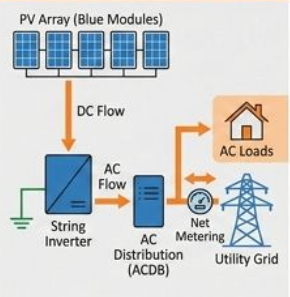
An On-Grid (or Grid-Tied) system connects your solar panels directly to the local electrical utility network by using an so called ongrid inverter.
During peak daylight hours, your solar panels supply power directly to your property. Any excess energy generated is fed back into the grid, often netting you credits with your utility provider. However, for safety reasons, standard on-grid systems automatically shut down during power outages to prevent feeding electricity into line repairs.
Important to know: An on-grid system does not generate electricity during power outages. Its main purpose is to lower your electric bill.
1.2 Off-Grid Systems
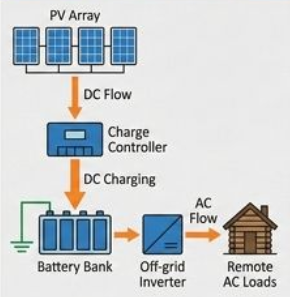
An Off-Grid system operates completely independent of the commercial power grid. Designed for remote locations or complete energy independence, off-grid installations rely on dedicated Battery Energy Storage Systems (BESS) to store power during the day and supply electricity throughout the night or on overcast days. Sizing an off-grid system requires precise engineering to handle peak loads and autonomy requirements.
Important to know: An off-grid system does not lower an existing utility bill. Instead, it provides reliable power where no public electrical grid exists or during extended power outages.
1.3 Hybrid Systems
A Hybrid system offers the ultimate versatility by combining grid connectivity with local battery backup. You benefit from net metering and grid reliability while storing excess energy in batteries. In the event of a blackout, the system
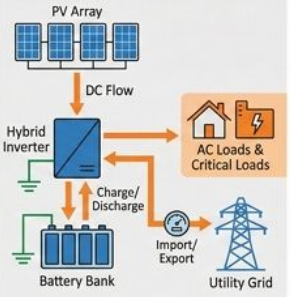
Important to know: A hybrid system gives you the best of both worlds: it lowers your electric bill and provides backup power during blackouts.
The Solar Advantage: Perfect Mexican Sun & Climat
Mexico stands out as one of the world's premier locations for solar power generation due to two major geographic advantages
- Optimal Peak Sun Hours: High-irradiance regions across Mexico consistently receive between 5.0 and 6.5 Peak Sun Hours (kWh/m²/day). This exceptional solar window translates directly into higher kilowatt-hour yield per installed panel compared to European or North American averages.
- Ideal Operating Climate: While extreme heat can reduce solar panel efficiency, many high-altitude regions (such as the Bajío area) offer bright, direct sunlight combined with moderate ambient temperatures. This balance keeps photovoltaic panels working near peak performance year-round.
2. Function of a Solar installation
2.1 Off-Grid Systems
What a On-Grid System Does:
- Directly Reduces Your Electricity Bill: During daylight hours, the system generates electricity that directly powers your home or facility. Every kilowatt-hour (kWh) generated by your panels is a kilowatt-hour you do not have to buy from your utility provider.
- Builds an Energy Credit Buffer (Net Metering with CFE): When your solar panels produce more electricity than your site consumes, the excess energy is exported back into the CFE grid througha bidirectional meter. This creates energy credits (a buffer) that automatically offset the power you draw from CFE at night or during low-sunlight days.
- Ensures Grid Safety via Anti-Islanding: Standard grid-tied inverters are equipped with mandatory anti-islanding protection. If CFE experiences a grid interruption, your inverter instantly detects the loss of voltage and shuts down within milliseconds. This prevents dangerous "back-feeding" onto utility lines, protecting linemen performing repair work.
What an On-Grid System NOT Does:
- No Power Backup During Blackouts: An on-grid system cannot supply electricity when the main grid goes down. Even under bright, perfect sunlight, the system will remain shut down as long as utility power is missing. It contains no energy storage (batteries) to establish its own independent voltage reference.
2.2 On-Grid Systems
What a Off-grid System Does:
- Captures and Stores Solar Energy: During daylight hours, the solar array generates electricity to power your immediate loads while simultaneously charging a dedicated battery storage system (BESS) for later use.
- Provides Uninterrupted Power Anywhere: It delivers continuous electricity using stored battery power whenever sunlight is unavailable—such as at night, during overcast weather, or in remote locations where no utility infrastructure exists.
- Operates Independently of Grid Status: Because the system creates its own internal microgrid reference, its power delivery remains completely unaffected by public utility blackouts or grid instability assuming there is a utility grid.
What a Off-grid System NOT Does:
2.3 Hybrid Systems
A Hybrid solar system represents the ultimate in flexibility and energy security. By combining solar generation, battery energy storage (BESS), and an active grid connection (CFE), it delivers the benefits ofboth on-grid savings and off-grid reliability.
What a Hybrid System Does:
- Delivers the "Best of Both Worlds": It operates seamlessly as an on-grid system to maximize daily utility savings while maintaining a charged battery reserve ready for immediate backup power.
- Reduces Your Electricity Bill: During peak sunlight hours, solar power directly supplies your loads and feeds excess energy back to the utility grid through net metering to build billing credits.
- Provides Uninterrupted Power During Outages:In the event of a blackout or grid collapse, the system automatically isolates itself from the utility line (islanding) within milliseconds, instantly drawing power from its batteries to keep your critical loads running without interruption.
- Protects You from Utility Dependency and Rising Rates: By storing excess solar production locally rather than relying purely on the grid, you gain independence from utility service disruptions, peak-demand charges, and future electricity rate increases.
What a Hybrid System Does NOT Do:
- Does Not Guarantee Infinite Power Without Load Management: While a hybrid system offers exceptional energy independence, your backup runtime during an extended blackout is limited by the size of your battery bank and daily solar replenishment. Critical load selection and smart energy management remain essential during prolonged outages.
3. Sizing a PV Solar System
A reliable solar energy installation relies on two primary hardware components that require precise technical engineering:
- Solar PV Panels: Responsible for harvesting sunlight and generating electric energy.
- Battery Energy Storage System (BESS): Responsible for storing generated energy for later consumption.
- The inverter: the component that converts the DC PV power into AC power.
Because every client’s usage patterns differ, both sub-systems must be sized based on specific site data, historical consumption, and future energy needs.
3.1 Sizing the PV Solar Panels
To calculate the necessary total array capacity (in kWp) and panel count, the engineering team evaluates the following key parameters:
- Historical Consumption (CFE Bills): Your recorded electricity consumption in kWh over the past 2 years to identify seasonal variations and peak billing cycles.
- Battery Recharging Requirements: The total daily energy needed to fully recharge the battery bank within a targeted solar window.
- Future Demand Growth: Anticipated increases in electricity consumption over the coming years.
- Planned High-Load Additions: Future integration of major loads, such as Electric Vehicle (EV) chargers or central Air Conditioning (A/C) units.
3.2 Sizing the Battery Storage Capacity in kWh
Sizing a battery bank accurately requires determining the customer's specific energy demand profile. This is established by creating a Load Profile, which relies on two core inputs:
- Appliance Inventory: The exact type, quantity, and power rating (in watts or kilowatts) of all connected electrical devices and equipment.
- Usage Schedules: Time-of-use patterns detailing how and when these appliances operate over a typical 7-day period (daytime vs. night time usage and weekday vs. weekend shifts).
3.3 Sizing the Inverter capacity in kW
Sizing the capacity of the inverter uses the load profile as in put but also detailed information of the client. If a client like to use a microwave to heat up a cub of water during blackout does not effect the load profile that much but definitely the size of the inverter.
↑ Return2TOC4. CFE Bill, Tariffs, Grid types and kWh
The applied tariff determines the cost per kilowatt-hour consumed but has direct impacts how much money a solar installation will save the client. How to read and Mexican electricity bill
4.1 Residential Tariffs
- Tarifa 1 (T1): The standard subsidized domestic tariff applied to low and moderate household consumption. Charges are structured in tiered blocks (Basic, Intermediate, Excess).
- DAC (De Alto Consumo): The High-Consumption Domestic tariff. Once a household exceeds the regional energy consumption limit over a 12-month rolling average, all government subsidies are stripped away, resulting in significantly higher cost per kWh rates. Solar is the most effective solution to pull a client out of DAC.
4.2 Commercial & Industrial Tariffs
- PDBT (Pequeña Demanda en Baja Tensión): Applicable to small commercial properties with low-voltage service and a connected demand of up to $25\kWh.
- GDBT (Gran Demanda en Baja Tensión): Applicable to commercial or industrial users connected to low voltage with a demand exceeding $25\kWh. Under GDBT, billing includes separate charges for energy consumption $\kWh and peak power demand $\kWh
4.3 Grid Connection Type
The grid service type defines the electrical layout of the property and determines the inverter specifications required for grid interconnection:
- Single-Phase (Monofásico): Standard 120V residential service using one live wire.
- Two-Phase / Split-Phase (Bifásico): Common 120V/240V residential and light commercial service using two live wires.
- Three-Phase (Trifásico): recidencial 120V/208V and commercial/industrial 220/440V service using three live wires, requiring balanced phase distribution across the solar array.
4.4 Consumption

The front of the CFE bill shows the electricity consumption measured over the last two months. This consumption what you pay for is expressed in kilo Watt hour or kWh. The unit kWhr is the energy equal to 1kW electric power used during 1hour. If you used 210 of the 1kWh units we say that you have consumed 210kWhr. It is this kWhr use over a longer time that is used to calculate the size of you PV solar panels.
4.5 Consumption over a 2-Year History
At the back of the bill you find a graph that summarises your consumption over a period of 2 years. The consumption of the last period you need to pay is not added to bar graph at the back of the bil.Page 8 of 18 The consumption graph on the CFE bill details energy usage in kWh over the last 12 to 24 months (6 to 12 bimonthly billing cycles). Analysing this historical data allows engineers to:
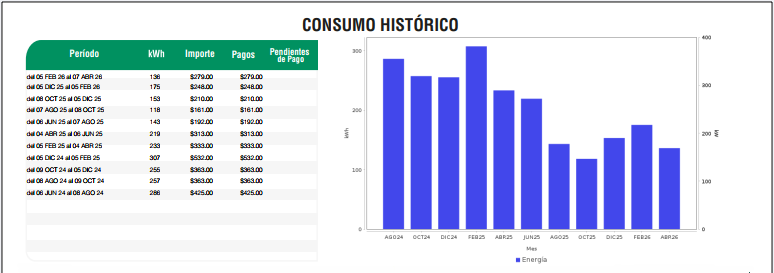
- Identify seasonal usage spikes (e.g., increased air conditioning load during summer months).
- Establish a precise average daily consumption benchmark.
- Size the solar photovoltaic array to accurately offset annual demand and build an optimal net-metering energy buffer.
This bar graph is the input for the sizing of the PV solar panel array.
↑ Return2TOC5. Solar benefits
Investing in a solar photovoltaic system has benefits and represents far more than a simple upgrade to your property's electrical infrastructure—it is a strategic decision that delivers long-term financial return, operational resilience, and energy autonomy. Whether installed for a residential property or a commercial facility, solar technology transforms electricity from an ongoing, unpredictable monthly expense into a self-sustaining asset. No more surprises By generating clean power directly on site, system owners effectively lock in their energy costs, shield themselves from rising utility tariffs, and gain critical protection against local grid instability. The following sections outline the key financial, technical, and operational advantages of investing into solar energy.
5.1 Lower Electricity Bills
Installing a solar energy system directly reduces your monthly reliance on the commercial power grid. By generating your own clean power during peak daylight hours, you immediately cut down the kilowatthours (kWh) purchased from CFE. Excess production can be fed back into the grid through net metering to generate energy credits for nighttime use. Over time, these cumulative savings yield a strong, predictable return on investment that pays for the system itself.
5.2 Increased Property Value
Solar panel installations are premium structural and energy upgrades that measurably increase a property’s resale value. Homes and commercial buildings equipped with functioning solar arrays appeal strongly to modern buyers seeking lower operational overhead and green energy features. Unlike traditional renovations, solar systems deliver immediate utility cost reductions from day one. This makes the property significantly more competitive and valuable in the real estate market.
5.3 DAC Tariff Escape
When domestic energy consumption exceeds CFE limits, households are pushed into the HighConsumption Domestic (DAC) tariff, stripping away all government subsidies and causing bills to surge. Solar PV systems offer the fastest and most reliable way to pull your property out of DAC status. ByPage 9 of 18 offsetting grid consumption with solar power, your net usage drops back below the threshold. CFE then reclassifies your service back to a subsidized residential tariff, dramatically lowering your rates.
5.4 Stable Electricity Grid
Local utility grids often suffer from voltage fluctuations, brownouts, and unexpected service interruptions during peak demand or severe weather. A solar system equipped with hybrid or off-grid battery storage provides instantaneous islanding protection, isolating your property from grid collapses. This keeps your essential circuits, security systems, and critical electronics continuously powered. Rather than relying on an unstable public line, you maintain a steady, clean, and controlled internal power supply.
5.5 Pays for Air Conditioning consumption
Air conditioning is typically the largest contributor to high summer electricity bills, forcing many owners to limit thermal comfort to control costs. A properly sized solar array produces its maximum energy output precisely when solar irradiance and ambient temperatures are highest—coinciding perfectly with peak A/C demand. This allows you to run cooling systems freely throughout the hottest hours of the day without fear of utility bill penalties.
5.6 Electric Vehicle Battery Charge by PV
As electric vehicles (EVs) become more common, home and commercial charging can significantly increase overall daily energy demand. Charging an EV from the grid simply shifts your transportation fuel expenses onto your monthly CFE bill. Integrating solar generation lets you fuel your vehicle directly from zero-cost, self-generated solar energy. This turns your solar investment into a complete home-andmobility energy solution that eliminates both gasoline and grid charging costs.
5.7 Up scalable When Electricity Demand Changes
Modern photovoltaic systems are engineered with modularity in mind, allowing them to expand seamlessly as your power needs grow over time. If you later decide to install a swimming pool, add more air conditioning units, or expand your facility, your solar capacity can be upgraded accordingly. Additional panels and microinverters or battery modules can be added to the existing balance of system. This ensures your initial investment remains flexible and adaptable to future lifestyle or operational changes.
5.8 Price and Inflation Independent
Utility energy rates and fuel costs consistently rise over time, exposing homes and businesses to unpredictable inflation and tariff restructuring. Investing in a solar energy system locks in your long-term energy generation costs at a fixed, permanent level. Once installed, the sunlight powering your system remains entirely free and immune to economic inflation. This delivers long-term financial certainty and protects your monthly budget from future utility price hikes.
5.9 Legal and Tax Benefits (ISR Deduction)
In Mexico, the federal tax framework offers strong financial incentives for renewable energy adoption under the Income Tax Law (Ley del Impuesto sobre la Renta - ISR). Article 34, Section XIII allows businesses and qualified individuals to perform a 100% first-year accelerated depreciation deduction onPage 10 of 18 capital investments in solar and renewable energy equipment. This substantial tax benefit lowers your net taxable income in the year of purchase, significantly shortening the payback period of the system.
↑ Return2TOC6. Warranties & Equipment Quality
High-performance solar installation depends on top-tier components and precision engineering. To ensure long-term system reliability, financial security, and peace of mind, every project is backed by comprehensive multi-tier warranty coverage:
Solar Panel Warranties: We utilize high-efficiency Tier-1 photovoltaic panels engineered for durability against high thermal stress and harsh weather. These modules feature a 12-to-15-year product warranty against manufacturing defects, alongside a 25-to-30-year linear performance warranty guaranteeing at least 80% to 85% power output efficiency over their operational lifespan.
Inverter Warranties: The inverter serves as the central brain of your system, converting direct current (DC) into clean alternating current (AC). Depending on whether string inverters, hybrid inverters, or microinverters are specified, standard factory coverage ranges from 10 to 25 years, ensuring continuous energy management and monitoring.
Workmanship Warranty: Beyond equipment guarantees, our installation team adheres to rigorous technical standards for structural mounting, DC/AC wiring, grounding, and grid connection. We provide a dedicated workmanship warranty covering all physical installation labor, structural roof penetrations, and electrical connections to guarantee leak-free, code-compliant integration.
Proactive Maintenance & Support: While solid-state solar components have no moving parts, routine maintenance—including periodic visual inspections, thermal imaging checks, and panel cleaning—is essential to preserve peak generation. Our preventive service protocols safeguard your equipment warranties, prevent premature efficiency losses, and maximize your return on investment over decades of operation.
In short Warranty:
- Panel manufacturing: 12-15
- Panel degradation defects: 25-30 years
- micro Inverter manufacturing: 10-15 years
- Hybrid Inverter manufacturing: 2-3 years
- Workmanship: 2-5 years
- Maintenance: contract dependent.
7. Installation Requirements
Before designing and mounting a photovoltaic solar array, a thorough structural assessment of the roof is required. Ensuring proper physical access, adequate space, and an unshaded installation site is critical for both installation safety and long-term energy production.
7.1 Key Roof Conditions for a Solar Installation
Key roof condition that installers will investigate are the following
- Save Roof access
- Space allocation for panel array
- Shade exposure
- Clear surface free of obstacles
Safe Roof Access
- The site must allow safe, unrestricted access for installation technicians, mounting materials, and heavy components. Permanent or secure access paths (such as exterior stairs, service hatches, or dedicated ladder placement areas) are necessary not only during the initial build, but also for ongoing system inspection, cleaning, and preventative maintenance. Space Allocation 3m² per Panel
Space Allocation 3m² per Panel
- As a engineering baseline, allow approximately 3m or 33sqft² of net roof area per solar panel. This footprint accounts for the dimensions of modern high-wattage panels, structural mounting rail spacing, row-to-row spacing to prevent self-shading, and mandatory perimeter maintenance walkways required by electrical safety codes.
Shade-Free Exposure (Trees & Tinacos)
- Photovoltaic modules require unobstructed direct sunlight throughout the day to achieve peak generation. Nearby trees, parapet walls, neighboring buildings, and common rooftop structures —particularly water storage tanks (tinacos) and solar water heaters—must be analyzed for shading. Even partial shading on a single panel can significantly reduce the output of an entire string of modules.
Clear Surface Free of Obstacles
- The designated installation zone must be free of structural obstructions such as vent pipes, satellite dishes, air conditioning units, or loose debris. A clear, level mounting area ensures proper structural anchoring, uniform wind-load distribution, and optimal drainage under and around the racking system.
8. Solar Remote Monitoring
Think of your solar inverter as the brain of your home's power setup. Today’s top inverter brands come loaded with built-in Wi-Fi and Bluetooth, connecting straight to a cool smartphone app—kind of like a fitness tracker, but for your electricity!
8.1 What You Can Do with the App
Check Your Power Anytime, Anywhere (Remote Access): Whether you’re at school, chilling at a friend’s house, or on vacation, you can open the app on your phone and see real-time graphics of your system. You can watch live as the solar panels soak up sunlight, see how fast your battery is charging, and check how much power your house is using right that second.
8.2 Your Personal Solar Dashboard
You get your own private account linked to your home's solar setup. The app logs all your stats over time, turning your energy generation into easy-to-read charts. You can look back at yesterday, last month, or even last summer to see how much clean energy you produced and how much money your family saved on power bills.
8.3 Instant Alerts & Error Checks
The app constantly runs checks in the background to make sure everything is running smoothly. If a circuit trips or the grid goes down during a storm, the app sends a pop-up notification right to your phone—and it can even alert the technicians so they can fix things remotely before you even notice a problem
↑ Return2TOC9. Sales Process
9.1 Phase 1: Request For Proposal RFP
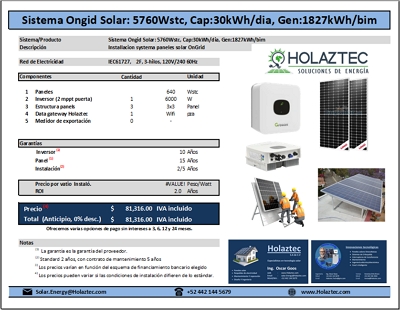
When someone is interested in getting solar panels for their home or business, we first need a few basic details to build an initial proposal. here is what we ask for:
- CFE bill, (in case of On-grid solar systems)
- Load profile (in case of hybrid or off-grid systems)
- Contact details (full name, phone Nr., email, address)
It's super helpful to figure out how the client plans to pay right from the start. If they want to use financing—like taking out a loan or making monthly payments—we need to include those extra costs in their price quote so there are no surprises later.
If we don't know their preferred payment method yet, asking about it is the very first thing we do at the start of Phase 2.
After we send the proposal to the client, the next step depends entirely on their response:
If they don't reply right away: We follow up with a quick call or message to answer any questions, gather feedback, and see what they think of the proposal.
If they accept the estimated quote: We schedule an on-site visit to kick off Phase 2of the sales process. This is where we do a final site inspection, finalize the official agreement, and lock in the Phase2: Site Visit & the Final .
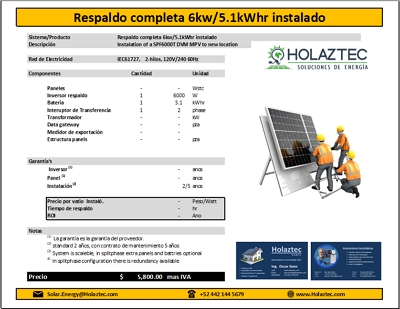
9.2 Phase2: Site Visit & the Final Price Offer
Once Phase 1 is wrapped up, we move into Phase 2. The main goal here is to collect all the necessary details on-site so we can give the client a binding final price quote.
9.2.1 Step 1: Payment Confirmation
The very first thing we do in Phase 2 is confirm how the client plans to pay. Experience shows that some clients don’t realize how much a solar system costs and expect the installer to figure out a way to pay for it! If the client doesn’t have a realistic way to fund the project, the process stops right here.
9.2.2 Step 2: Project Planning & Terms
If the client has their funding sorted out, we sit down to map out the schedule. Both sides agree on a start date, how long it will take to order parts, and how many days the actual installation will take on-site. The project officially begins once the client pays a 50% deposit.
9.2.3 Step 3: Technical Site Visit Checklist
Next, our team conducts a physical site inspection to collect technical data and inspect the property. During this visit, we:
- Gather Client & ID Details: Get all required personal details and ID copies needed to draft the Power of Attorney (Carta Poder) letter. This lets us handle the official CFE interconnection contract changes on their behalf.
- Inspect CFE Equipment: Locate the CFE electric meter and confirm the grid service type (1, 2, or 3 phases).
- Count Distribution Panels: Ask how many electrical panels exist in the house or office building.
- Check the Main Breaker: Inspect the condition of the main breaker where the solar system will connect to the grid.
- Check Panel Capacity: Examine the main distribution box to ensure there is enough physical space to add the new solar breakers.
- Test Wi-Fi Signal: Measure the Wi-Fi signal strength right where the inverter will be installed, and save the network name (SSID) and password for setup.
- Inspect Roof Feasibility: Evaluate the roof’s surface condition and structure for mounting the solar array.
- Plan Material Transport: Figure out the safest way to lift heavy panels and mounting hardware up to the roof.
- Set Expectations: Inform the client that we may need to drill anchor holes into the roof and run conduit pipes through walls.
- Review Future Plans: Confirm system capacity and check if they want to plan for future expansions (like adding an EV charger or more panels later).
Finalize the site visit with agreement on when the first payment will be done.
9.3 Phase 3 : Installation
Ones the first payment is received the ordering process will start. Depending on the type of solar system the basic components to order are:
On-Grid solar materials for and installation
- Solar panels
- Off-Grid Inverter
- Panel Frame
- DC switch AC switch
- Conduit Cables and clamps
- MC4 connectors soldering materials
Off-Grid & hybrid solar materials for and installation
- Solar panels
- Battery
- Off-Grid Inverter + Charger
- ATS switch
- Panel Frame
- DC switch AC switch
- Conduit Cables and clamps
- MC4 connectors soldering materials
Panels will be order an directly delivered the address of the client. The client need to be at home when the panels are delivered.
Ones all materials are ordered and delivered to the client the next payment of 40% will be requested. One that payment is received the installation will be started and finished.
9.4 Phase 4: The CFE Contract change
Even though all the solar panels and equipment are mounted on the roof, the system cannot be turned on right away.
9.4.1 Step 1: The CFE Meter Problem
Your current electricity meter only counts power flowing in one direction—from CFE into your home. If you turn on the solar panels now, the old meter might accidentally count your self-generated solar energy as extra power bought from CFE!
To fix this, your utility agreement must be updated from a standard consumption contract to a two-way solar contract. This official CFE procedure is called:
Solicitud de Interconexión de Centrales Eléctricas de Pequeña Escala
As part of this process, two official documents are signed:
- Contrato de Interconexión: Permission from CFE allowing your solar panels to link up with their public power grid.
- Contrato de Contraprestación: The agreement (usually under Medición Neta / Net Metering) that sets up how CFE will track and credit the extra power you send them.
The change of contract process tramite can take 18 days....2 months depending on the progress with in the CFE. This part is out of control of the sales process and depends completely on the CFE organistaion.
9.4.2 Step 2: Replacing the Meter
Once CFE approves the paperwork, a technician comes out to your property. They remove the old single-direction meter and install a new bidirectional meter, which can measure power moving in both directions.
9.4.3 Step 3: System Activation & App Setup
Now that the new meter is installed, the solar system can finally be switched on and connected to the grid! At this point, we configure the online monitoring system so you can start tracking live solar production from your computer or phone app.
9.4.4 Step 4: Final Payment & Handshake
Once everything is tested and working perfectly, the customer pays the remaining 10% final balance. This payment completes the deal and officially marks the successful end of the project!
↑ Return2TOC10. Financing & Payment Options
People want different option to pay for an solar installation. Holaztec can offer three forms of payments sceams. These are.
- Bank transfer
- Credit card
- Credit with “free” months.
Nothing in banking land is free the free months you have using MSI is free from perfective of the client but behind that MSI price you pay for you loan. Holaztec offers client specific prices per installed system so we include the extra costs we make for MSI or credit card in the offer.
10.1 Bank Transfers
This is the preferred and most effective method to pay. The client makes a bank transfer and ordering can start the client have no extra costs.
10.2 Payment by Credit Card
You can pay using your credit card but that comes with a 2.5% cost.
10.3 Credit with “Free” months payments
You can pay with 3,6 9,12,24 month free of costs. This means the cost which holaztec makes for this payment will integrate that in the offer. The percentage we calculate are based on the bank tariffs Holaztec has. These percentage are ad can change over time
- 0 months : 2.6%
- 3 Months : 3.5%
- 6 months : 5.5%
- 12 months : 8.5%
- 24 Month : 11.5%
10.4 Invoices
When you have a business and are registered with the SAT we can make Invoices.
↑ Return2TOC11. Price list
This price list is and indicative list the true prices in the sales proposals Holaztec uses in the sales process. Based on 640W solar panels a Hoymiles micro inverter and a 220V CFE contract.
| Nr | Panel | Power | Capacity | Price | T1-ROI | DAC-ROI |
|---|---|---|---|---|---|---|
| nr | [kW] | [kWh] | $-MXN | Year | Year | |
| 1 | 1 x 640W | 640 | 193 | $22900,- | 4.9 | 2.0 |
| 2 | 2 x 640W | 1280 | 386 | $27800,- | 3.4 | 2.0 |
| 3 | 3 x 640W | 1920 | 579 | $32600,- | 2.7 | 2.0 |
| 4 | 4 x 640W | 2560 | 772 | $35000,- | 2.2 | 2.0 |
12. Understanding Return on Investment (ROI)
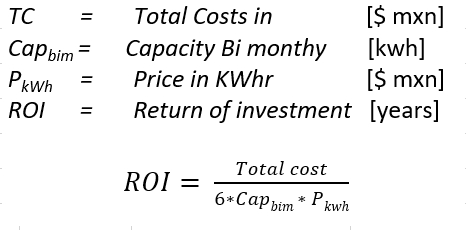
To see how profitable a solar investment is, we use this formula:
12.1 What Can We Learn From This Math?
Who read this formula can read several things in it. And if you combine it with table 11.1 of chapter11 something interesting shows up.
- Bigger Systems Win on Efficiency: When you look at system prices, as shown in Table 12 Cost of On-Grid Installations, the cost of an installation does not scale linearly. Adding twice as many panels doesn't double your total price because baseline expenses—like the main inverter, wiring, permits, and labor—are already covered.
- Savings Outpace Panel Costs: Because your Savings per Bimonth grows directly with every panel added while the cost per panel goes down, larger systems pay themselves off in fewer bi-monthly billing cycles and generate a much higher overall ROI (%) over their 25-year lifespan.
- Planning for the Future: If a client expects their energy consumption to rise in the future (like buying an electric car or adding air conditioning), oversizing the system slightly from day one delivers a much stronger financial return than adding panels later.
It's pretty amazing what simple math can teach us about designing the perfect solar setup
↑ Return2TOC