Hi,
I recently acquired a 16-cell LiFePO4 battery pack that had been left in a fully depleted state. After successfully performing a recovery charge, I’m looking for your technical insights regarding its long-term health and expected performance characteristics.
What I did
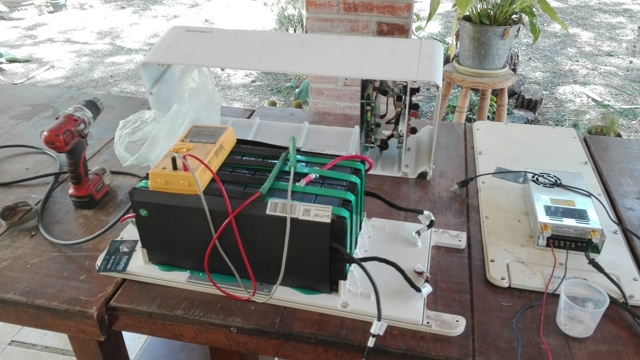
I’m looking for reasoned opinions about a fully discharged Growatt ARK2.5L-A1 LiFePO4 battery. This battery was completely discharged for months, with a cell voltage of 0.3V. The BMS was not working due to this low voltage, so I opened the casing. After opening it I checked the 16 cells for deformation and didn’t see any. I started to recharged it with a 0.1A current from 5V to 32V. Then, I went from 32V to 40V (cell voltage) at 0.3A, followed by 40V to 54.4V at 5A. Finally, I charged from 54.4V to 58V using absorption charging.
What I found
My observations with nothing connected other than the S16 cells in series:
- At 32V: The voltage drops by 0.6V over a day. Initially, the drop is fast, but it slows down significantly compared to the first few hours.
- At 54.4V: The terminal voltage drop is around 0.8V, but it stabilizes faster and stops dropping.
- At 58V: The terminal voltage drops quickly by about 0.8V, but over many days, it stabilizes at 54.8V.
What I Know
I am aware that the 0–32V and 54.4–58V ranges are the steep sections of the LiFePO4 voltage curve. My initial thought was that any losses due to increased internal discharge would show up in these areas. The information I received was that disconnecting a LiFePO4 battery from a charger causes the voltage to drop by about 0.8V as a result of “settling voltage” or “Voltage relaxations”. The terms Voltage Relaxation or Settling Voltage for LiFePo4 batteries seems to be important here.
What is it that you know
Based on what I saw and measured, what are your reasoned opinions? Is this battery healthy and safe to use, or not?
Leave your commends below, Hope to see what you have to say about this.
Regards, and thanks for your help