To the Hiring Manager or Talent Acquisition Specialist,
Thank you for reviewing my profile and contacting me by email
As a senior project manager and systems engineer operating through my own registered company, I specialize in the hands-on delivery of complex BESS (Battery Energy Storage
Systems), hybrid power microgrids, and telecommunications infrastructure.
Over my career, I have managed projects end-to-end—from system architecture and hardwareintegration to testing, acceptance management, site commissioning, and stakeholder alignment. I focus on long-term, high-reliability design and stepping into active project environments to streamline team execution, resolve technical bottlenecks, and keep delivery on schedule.
In addition to standard freelance contracts, I operate as a fully registered corporate entity (Holaztec S.A. de C.V.). This allows me to offer your client or organization a flexible, plugand-play B2B vendor relationship with seamless cross-border compliance and zero local employment overhead.
In the following pages, you will find my detailed professional history, technicalqualifications, and project track record. If you see an alignment with your active or upcoming project mandates, I propose scheduling a brief call to discuss how I can support your operational goals.
I look forward to connecting with you.
Best regards,
Oscar Goos
Lead Engineer & Business Owner | Holaztec S.A. de C.V.
Email: Solar.Energy@holaztec.com
Tel / WhatsApp: +52 442 144 5679
Location: Querétaro, Mexico (Available for Global / Remote & Field Deployments)
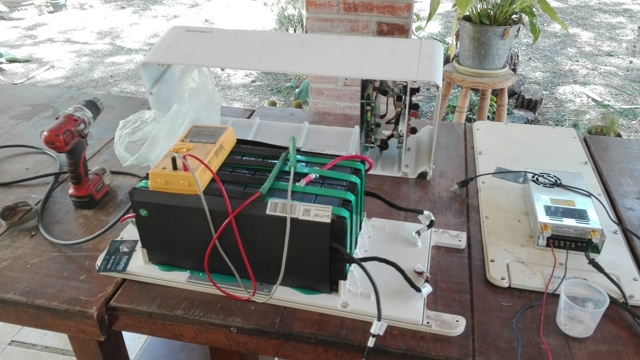
I recently acquired a 16-cell LiFePO4 battery pack that had been left in a fully depleted state. After successfully performing a recovery charge, I’m looking for your technical insights regarding its long-term health and expected performance characteristics.
What I did
I’m looking for reasoned opinions about a fully discharged Growatt ARK2.5L-A1 LiFePO4 battery. This battery was completely discharged for months, with a cell voltage of 0.3V. The BMS was not working due to this low voltage, so I opened the casing. After opening it I checked the 16 cells for deformation and didn’t see any. I started to recharged it with a 0.1A current from 5V to 32V. Then, I went from 32V to 40V (cell voltage) at 0.3A, followed by 40V to 54.4V at 5A. Finally, I charged from 54.4V to 58V using absorption charging.
What I found
My observations with nothing connected other than the S16 cells in series:
At 32V: The voltage drops by 0.6V over a day. Initially, the drop is fast, but it slows down significantly compared to the first few hours.
At 54.4V: The terminal voltage drop is around 0.8V, but it stabilizes faster and stops dropping.
At 58V: The terminal voltage drops quickly by about 0.8V, but over many days, it stabilizes at 54.8V.
What I Know
I am aware that the 0–32V and 54.4–58V ranges are the steep sections of the LiFePO4 voltage curve. My initial thought was that any losses due to increased internal discharge would show up in these areas. The information I received was that disconnecting a LiFePO4 battery from a charger causes the voltage to drop by about 0.8V as a result of “settling voltage” or “Voltage relaxations”. The terms Voltage Relaxation or Settling Voltage for LiFePo4 batteries seems to be important here.
What is it that you know
Based on what I saw and measured, what are your reasoned opinions? Is this battery healthy and safe to use, or not?
Leave your commends below, Hope to see what you have to say about this.
Solar energy harnesses sunlight to generate clean, renewable electricity using photovoltaic (PV)
technology. Depending on how your power system connects to the electrical grid and energy storage,
solar setups generally fall into three main categories:
1.1 On-Grid Systems
An On-Grid (or Grid-Tied) system connects your solar panels directly to the local electrical utility network by using an so called ongrid inverter.
Figure 1.1: OnGrid solar system.
During peak daylight hours, your solar panels supply power directly to your property. Any excess energy generated is fed back into the grid, often netting you credits with your utility provider. However, for safety reasons, standard on-grid systems automatically shut down during power outages to prevent feeding electricity into line repairs.
Important to know: An on-grid system does not generate electricity during power outages. Its main purpose is to lower your electric bill.
1.3 Off-Grid Systems
Figure 1.2: OffGrid solar system.
An Off-Grid system operates completely independent of the commercial power
grid. Designed for remote locations or complete energy independence, off-grid
installations rely on dedicated Battery Energy Storage Systems (BESS) to store
power during the day and supply electricity throughout the night or on overcast
days. Sizing an off-grid system requires precise engineering to handle peak loads
and autonomy requirements.
Important to know: An off-grid system does not lower an existing utility bill.
Instead, it provides reliable power where no public electrical grid exists or during
extended power outages.
1.3 Hybrid Systems
A Hybrid system offers the ultimate versatility by combining grid connectivity with
local battery backup. You benefit from net metering and grid reliability while
storing excess energy in batteries. In the event of a blackout, the system
Figure 1.3: Hybrid system.
seamlessly isolates itself from the grid (islanding) and switches to battery power,
ensuring uninterrupted electricity for critical loads.
Important to know: A hybrid system gives you the best of both worlds: it lowers
your electric bill and provides backup power during blackouts.
The Solar Advantage: Perfect Mexican Sun & Climat
Important to know: A hybrid system gives you the best of both worlds: it lowers
your electric bill and provides backup power during blackouts.
The Solar Advantage: Perfect Mexican Sun & Climat
Mexico stands out as one of the world’s premier locations for solar power generation due to two major
geographic advantages
Optimal Peak Sun Hours: High-irradiance regions across Mexico consistently receive between 5.0 and
6.5 Peak Sun Hours (kWh/m²/day). This exceptional solar window translates directly into higher
kilowatt-hour yield per installed panel compared to European or North American averages.
Ideal Operating Climate: While extreme heat can reduce solar panel efficiency, many high-altitude
regions (such as the Bajío area) offer bright, direct sunlight combined with moderate ambient
temperatures. This balance keeps photovoltaic panels working near peak performance year-round.
1.1.1 Callouts and Floating Tables
Important Note
Callout boxes are ideal for drawing focus to contextual tips or important takeaways without interrupting section flow.
Vestibulum ante ipsum primis in faucibus orci luctus et ultrices posuere cubilia Curae; Morbi lacinia molestie dui. Praesent blandit dolor. Sed non quam.
Parameter
Value
Alpha
0.05
Beta
1.24
Table 1.1: Right-aligned table block.
Morbi in ipsum sit amet pede facilisis laoreet. Donec lacus nunc, viverra nec, blandit vel, egestas et, augue. Vestibulum tincidunt malesuada tellus. Ut ultrices ultrices enim. Curabitur sit amet mauris. Morbi in dui quis est pulvinar ullamcorper. Nulla facilisi. Integer lacinia sollicitudin massa.
Below are two framed items side-by-side and horizontally aligned at the top edge. The space between them is governed by the gap property on .wo-media-row. No body text flows into the gap or alongside the outer edges.
Figure 2.1a: Scaled graphic
Key
Data
X-Axis
100 px
Y-Axis
200 px
Table 2.1b: Related metrics
Text resumes cleanly below the centered side-by-side layout block, maintaining clean margins across the page width.
2.2 Glossaries & Reference Lists
Below is an example of a structured definition list for technical terminology or references:
Flexbox Layout
A CSS module designed for aligning items in one dimension (either rows or columns) with dynamic sizing capabilities.
Drop Cap
A decorative initial letter at the start of a paragraph that is larger than the rest of the text, extending down through multiple lines.